
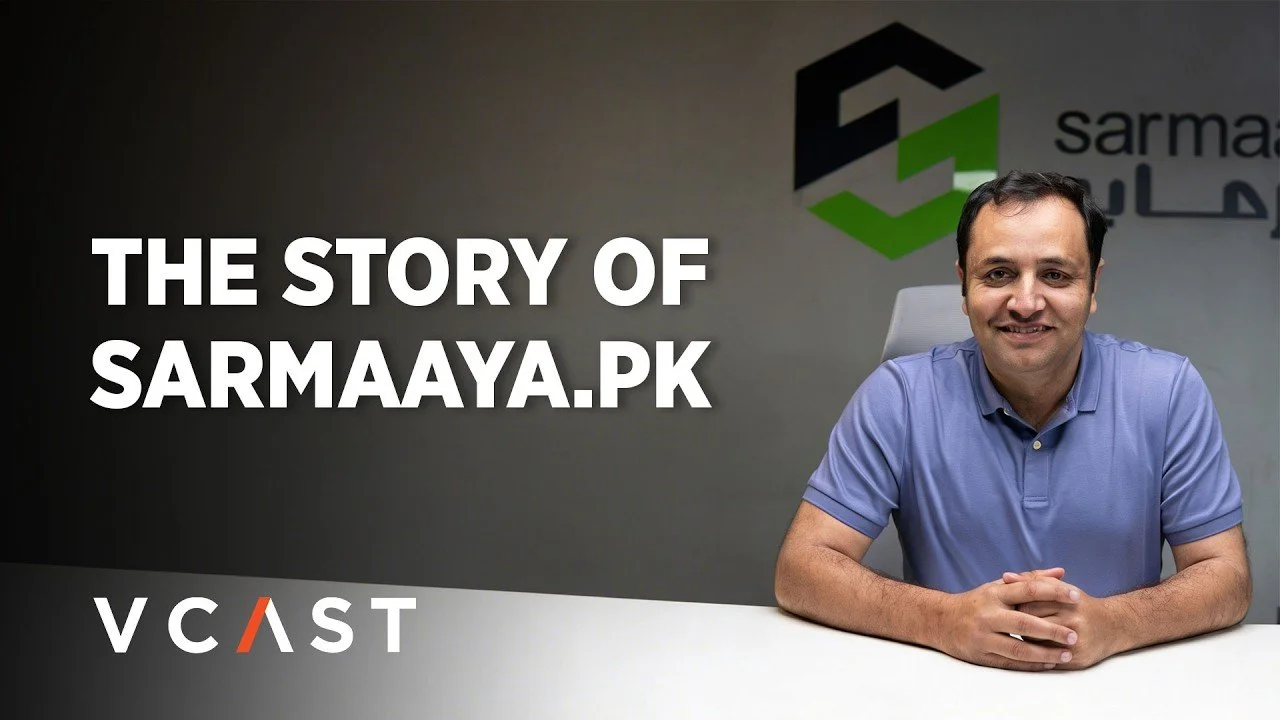
“The impact of this particular platform could be very significant in terms of society,” says Laeeq Ahmad, Founder and CEO of Sarmaaya Financials (Pvt) Ltd, the company behind Sarmaaya.pk, an independent financial research and portfolio tracking platform in Pakistan. His vision is to make financial information more accessible and help Pakistanis better understand investment opportunities in the country's capital markets.
Ahmad believes financial literacy can broaden access to wealth creation. In a market where many people have traditionally viewed stocks as a form of gambling, he wants to encourage investors to look beyond short-term price movements and understand the businesses behind the shares they buy.
Ahmad's path to entrepreneurship began in the technology sector. After graduating from the National University of Sciences and Technology (NUST), he started his IT career in 2005, spent a decade at Teradata, before he established his own tech company, ABC Data. Although he had obtained Australian permanent residency in 2017 and considered relocating, he decided to remain in Pakistan and pursue entrepreneurship.
Sarmaaya.pk was not part of his original plan. Alongside his technology business, Ahmad had pursued investments as an alternative source of income, but he says he lost almost all the money invested in that venture. Determined to understand what had gone wrong, he took financial training with Ammar Yasin, learning to interpret income statements, balance sheets and cash flow statements. The experience helped him recognise the need for accessible financial information and investment education.
That realisation became the foundation for Sarmaaya.pk. Ahmad envisioned a platform bringing together information on liquid investment options, particularly stocks and mutual funds. Initially offered free of charge, it attracted users who appreciated the data but wanted to know how to use it. He subsequently incorporated financial education into the platform, helping users connect company performance with investment decisions.
One moment proved especially influential. While developing a return-on-investment tool, Ahmad calculated that an investment of Rs100,000 in Unilever would have grown to Rs2.9 million. Ammar corrected the calculation to Rs29 million, a difference that changed Ahmad's perspective on the potential of long-term investing. The experience reinforced his belief that financial literacy could help more Pakistanis participate in wealth creation.
Ahmad formally registered Sarmaaya.pk with the Securities and Exchange Commission of Pakistan (SECP) in 2021. He says the venture was largely bootstrapped, with revenue from his technology business and gains from stock-market investments helping fund its development. Despite coming close to default in 2025, he says improved market conditions following the IMF agreement brought renewed activity to the market. He also reports that approximately 150,000 new investors entered the market over the preceding 18 months. The platform has since introduced monetisation to support its sustainability.
Beyond individual investors, Ahmad sees potential in helping businesses manage their capital more effectively. Through Zar, the business-facing offering, he aims to provide financial visualisation and support better decision-making for companies that may lack dedicated finance teams or struggle to assess investment performance. Better capital allocation, he argues, can help businesses increase productivity, expand capacity and grow market share.
Ahmad's ambitions extend beyond financial services. He argues that entrepreneurs who build businesses in Pakistan can contribute through employment, taxation and local economic activity. While acknowledging the difficulties of operating a business in the country, he believes the government should make it easier for entrepreneurs to establish and grow companies locally.
For Ahmad, building Sarmaaya.pk is about more than investment data. It is an effort to make financial knowledge more accessible while demonstrating how home-grown businesses can contribute to Pakistan's economic development.
Can better financial education and stronger support for entrepreneurs help more Pakistanis build lasting wealth at home? Share your thoughts in the comments.
This article was developed with the assistance of AI tools.
More Videos From This Campaign




Javed Ahmed on how Jubilee Life pioneered cashless microinsurance in Pakistan, making healthcare more accessible to lower-income families while technology continues to reshape the insurance industry.