Transforming Communities Through Education: The Story of DIL
Across Pakistan, tens of thousands of children—especially girls—continue to face obstacles to accessing quality education, shaped by poverty, distance, and deeply rooted social norms. For nearly three decades, the Development in Literacy (DIL) Foundation has worked to break down these barriers in underserved regions.
This feature explores how DIL’s work is not only expanding access to education but also reshaping attitudes and possibilities within the communities it serves.
Societal Resistance & Change
Even today, in parts of Pakistan, sending girls to school can carry serious social risks, from backlash to early marriage. In certain communities, families once feared the consequences of girls attending school.
“In certain schools in Balochistan, mothers would send their daughters to school when the father was away. When one father came home early and found his daughter at school, he burnt her books and beat his wife. Now, those same fathers are the ones who bring the girls to school themselves.”
— Fiza Shah, CEO & Founder - Developments in Literacy (DIL)
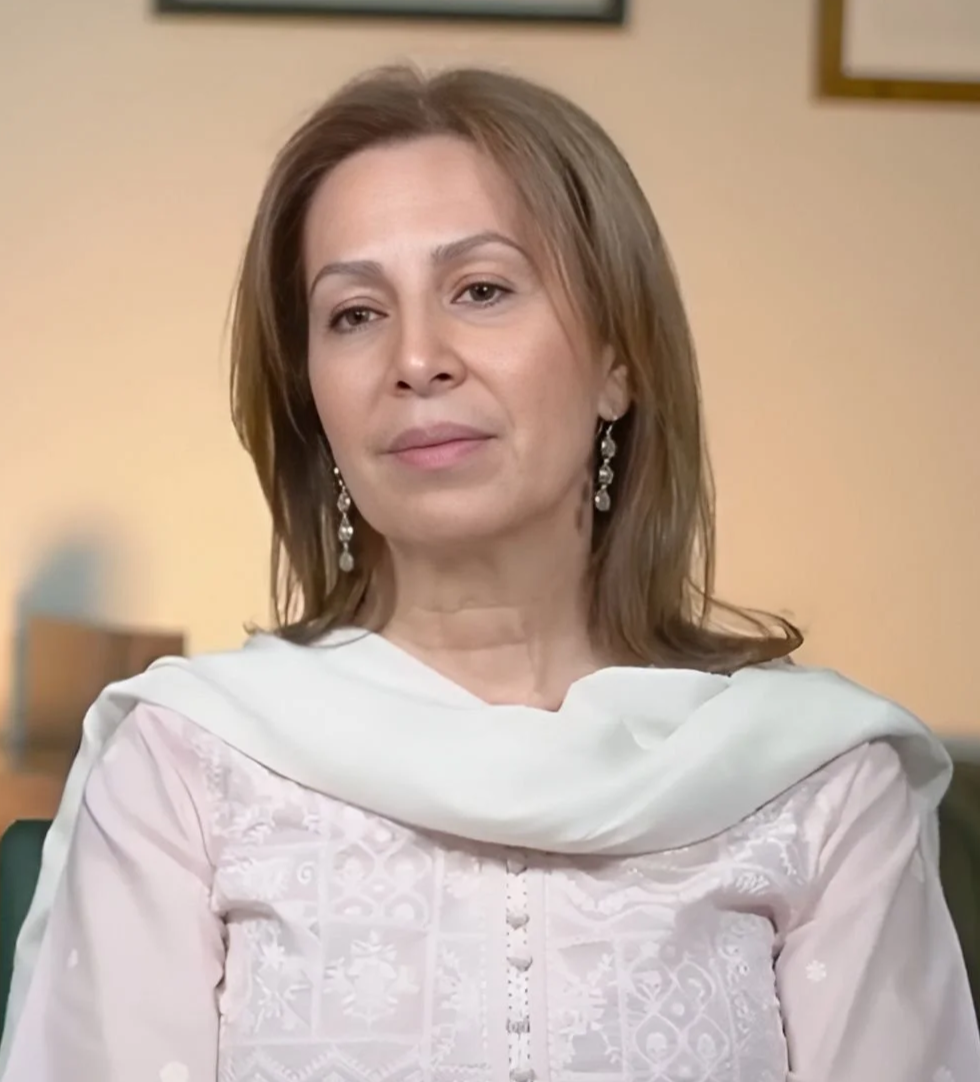
DIL’s work has helped shift these attitudes, showing families the tangible benefits of education and increasing opportunities for girls across rural Pakistan.
Journey of DIL: From Small Beginnings to National Impact
Born in Quetta, Fiza Shah founded DIL in 1997 with a vision to create learning opportunities for underprivileged children. What began as a modest 10-school project in Mianwali has evolved into a nationwide organization, serving nearly 90,000 students across Punjab, Sindh, Khyber Pakhtunkhwa, and the Islamabad Capital Territory (ICT).
Over the years, DIL has expanded its programs from primary education to matric-level schools, introduced life skills and university preparation programs, and implemented innovative teaching methods to improve student outcomes. The organization also prioritizes inclusive, gender-responsive classrooms, ensuring that every child—regardless of background—has access to quality education
DIL’s Reach Across Pakistan
90,000
Student Served
214
Students Across Pakistan
78%
Government-Adopted Schools
Transforming Classrooms and Learning
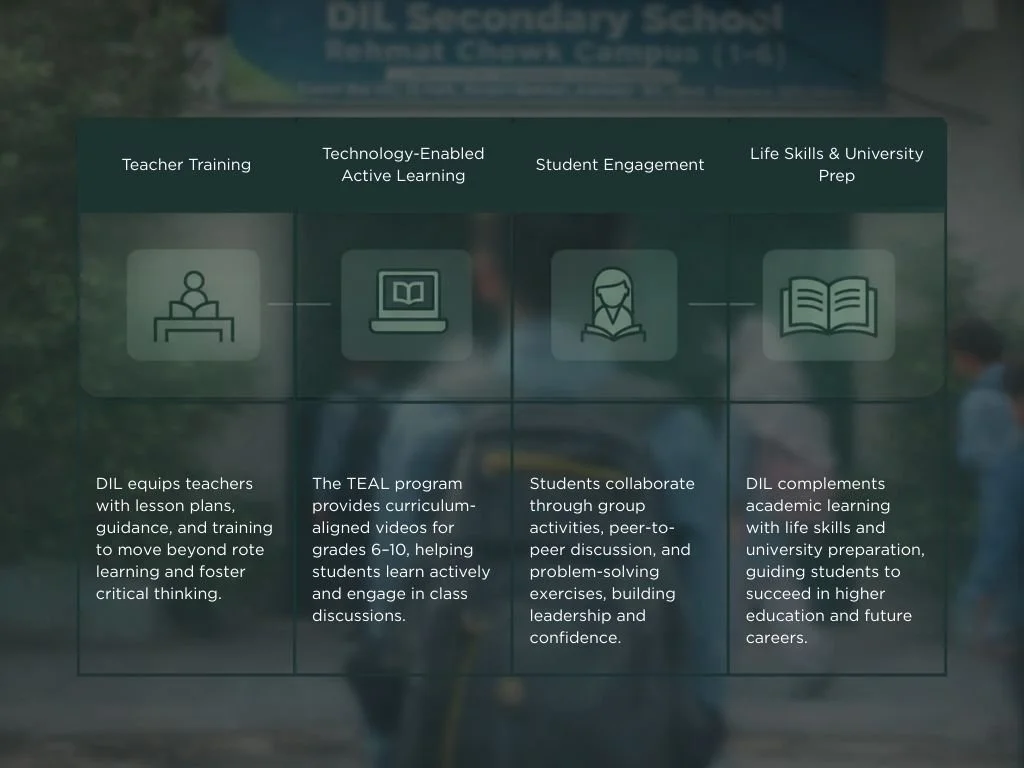
To reshape classrooms and strengthen learning outcomes, DIL equips teachers with structured guidance, lesson plans, and modern tools. Traditional rote memorization is replaced by interactive, student-centered approaches that cultivate critical thinking, collaboration, and problem-solving.
The Technology-Enabled Academic Learning (TEAL) program introduces curriculum-aligned videos into grades 6–10 classrooms. Students watch videos, discuss concepts, and participate in problem-solving exercises—shifting responsibility for learning to the students, while teachers guide and facilitate.
Classrooms now feature group activities, peer-to-peer discussions, and leadership development exercises. Children learn to articulate ideas, work collaboratively, and take ownership of their learning. These methods have increased student engagement, confidence, and academic performance while giving teachers the tools to foster meaningful learning experiences.
How DIL Students Are Changing Their Communities
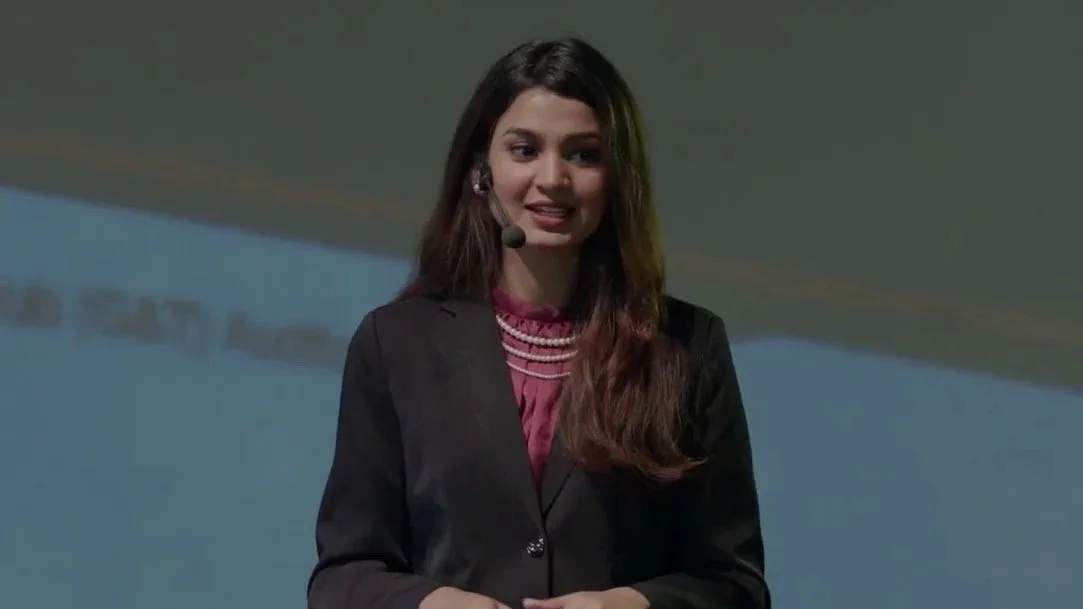
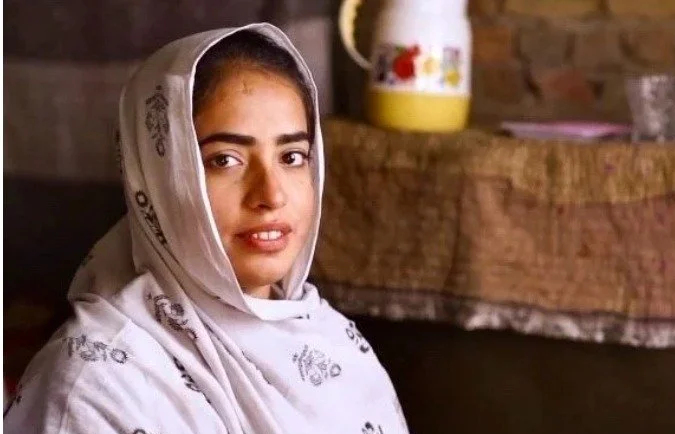
DIL’s impact is perhaps most visible in the lives of girls who have overcome social barriers to pursue education and careers.
Alumni Spotlight – Afreen Mushtaq (Harvard Graduate)
From Orangi Town, Afreen spent 12 years at DIL School, earning a full scholarship to IBA and later becoming a Fulbright Scholar at Harvard. She is a vocal advocate for girls’ education, featured among Pakistan’s 25 most influential young women, and has delivered a TED Talk that inspires communities nationwide.
Faiza Memon (Razal Memon, Khairpur, Sindh)
In a conservative village where boys’ education was prioritized, Faiza persuaded her father to let her study. Supported by DIL, she completed a degree in Electrical Engineering at Quaid-e-Awam University and returned to her community as a role model.
“I want every girl in Razal Memon to get an education. The future belongs to women.”
— Faiza Memon
These stories demonstrate how education can empower girls to challenge societal norms and become change-makers in their communities.
Understanding Milk Production in Pakistan
Pakistan generates 70 billion liters of milk annually - more than the entire European Union combined.
In most developed countries, the distribution of loose milk is banned altogether; however, most of this milk produced in Pakistan goes through the informal sector which distributes loose milk.
Pakistan is the
4th
largest milk producing country in the world
95%
milk in Pakistan flows through informal channels
97%
milk in Pakistan is not processed
Milk Supply Channels & Points of Contamination
The supply chain remains dominated by middlemen known as dodhis, who collect raw milk from farmers and distribute it—often without refrigeration or quality testing. This informal system leads to rapid spoilage and frequent contamination, as milk is often transported in unsanitary conditions and sometimes adulterated with unclean ice to prolong shelf life. Health experts in Pakistan have also found some milk distributors selling milk in open containers, layered with flies and bacteria.
Formal milk processors take out the middleman, purchasing milk directly from the milk producers—the farmers.
This does not, however, resolve all contamination challenges, as many farmers also resort to dangerous practices like using low quality feeds and excessive antibiotics (to boost production), leaving harmful residues in the milk supply that can cause diseases as well as antibiotic resistance in consumers. The traditional process of hand-milking a cow—often in unhygienic conditions—also results in milk contamination.
The formal sector addresses these issues by requiring milk producers to meet a strict set of requirements for the cow; investing in cold-chain infrastructure to store and transport the milk; pasteurizing and sterilizing the milk; enforcing hygiene standards in processing plants; and using multi-layered, airtight packaging.
“From the milking, all the way up to the glass table, there are more than 29 different quality tests performed by the formal dairy sector to ensure that you are getting a complete, wholesome, nutritious glass of milk.”
— Dr. Shehzad Amin
CEO, Pakistan Dairy Association
Milk Adulteration in The Informal Sector
Dodhis have a stronghold on the informal dairy sector; consequently, many milk farmers do not get their fair share of profits from milk sales. As a result, some engage in practices like the use of oxytocin injections, which artificially increase milk production but pose serious health risks to both animals and consumers. Moreover, since buffalo milk commands a higher price due to its richer fat content, farmers often blend it with cheaper cow milk while still selling it as pure buffalo milk.
As the milk moves to dodhis, the adulteration intensifies and continues till the wholesale and retailer level. To stretch their profits, milkmen dilute the milk with water, significantly reducing its nutritional density. Then to mask this dilution, they add thickeners like starch, flour, or powdered milk, restoring the appearance of richness without the actual nutritional benefits. Some even mix in detergents or vegetable oils to mimic the creamy texture and froth that consumers associate with high-quality milk.
Furthermore, with no proper cold storage infrastructure in the informal sector, milk spoils quickly during transportation. To combat this, traders add chemical preservatives like formalin, hydrogen peroxide, and urea—substances that prevent bacterial growth but are toxic to human health. Vendors further adulterate milk by adding whitening agents like caustic soda or bleaching chemicals to make stale milk appear fresh and appealing.
The final victims of this system are consumers. Many remain unaware of the dangers of loose milk, assuming that boiling milk makes it safe, not knowing that toxins like formalin and heavy metals cannot be removed by heat.
Myths Around Milk Consumption
Myth 1: “Raw Milk is More Nutritious”
One of the most persistent myths in Pakistan is that "fresh" loose milk is healthier than processed (UHT/pasteurized) milk. This misconception is so widespread that even some medical professionals perpetuate it, unaware of the serious health risks tied to raw milk.
“Unfortunately, the consumer in Pakistan thinks that UHT (Ultra-high-temperature-processing) is a technology whereby, to get a longer shelf life, we add preservatives to the milk—which is totally wrong. The whole UHT process and packaging makes sure there’s no organism in it, and nothing from the outside can get in. That’s how you get a longer shelf life.”
— Sulaiman Monnoo
CEO, Dairyland Private Limited
In fact, in 2016-17, the Supreme Court ordered analysis of UHT and pasteurized milk brands. The report showed that out of six samples of UHT milk, five were safe to consume; whereas, only one out of ten samples of pasteurized milk was safe to consume.
Myth 2: “Companies Remove All The Goodness from Packaged Milk”
A common misconception is that packaged milk is "nutritionally empty" because companies allegedly remove its cream to sell as a separate product. But the reality is that modern milk processing uses homogenization—a mechanical process that distributes fat molecules evenly throughout the milk. This prevents cream separation while preserving every nutrient, including proteins, calcium, and vitamins.
Different Regulatory Standards: The Formal vs. Informal Sector
There have been some attempts to check the quality of loose milk: a Punjab Food Authority crackdown on milk entering cities in 2019 found that 422 out of 601 loose milk samples were contaminated or adulterated and had to be thrown away. However, ultimately, only a fraction of these samples get checked, as food authorities find it challenging to identify the various points of production, distribution, and contamination in the informal sector. Furthermore, even if pure milk enters the cities, it can get adulterated at shops.
On the other hand, the farms, factories, and processing plants in the formal sector are documented and much easier to regulate; therefore, they go through a rigorous quality check process. The formal sector is made to abide by food safety laws and frequently undergoes inspection and testing.
The Economic Problem & Perverse Incentives
Pakistan’s packaged milk is one of the most expensive in the world.
Formal sector prices have been driven up by 18% federal taxes on packaged milk—making the average packaged milk consumer spend 500 rupees on milk per day. This has made safe, processed milk unaffordable for most, forcing families to rely on the informal loose milk market.
But here, another crisis unfolds: seeing the rise in formal sector prices, dodhis have artificially inflated prices, pocketing an estimated 1.3 trillion rupees while consumers continue to suffer. Dairy farmers also do not benefit from rising retail prices, as they remain trapped in a system where middlemen control the profit.
“Loose milk (a characteristic of the informal sector) cannot be measured, and that’s why no standard can be applied to it, even if it’s Pakistan’s standard. You can’t have two playing fields—a formal dairy industry, adhering to certain standards, being taxed at probably the highest rates in the world, and an informal dairy industry, with no standards or control over the product, not being taxed.”
— Usman Zaheer,
CEO, Fauji Foods Limited
The solution?
“In my opinion, the government should provide a subsidy to all healthy foods rather than taxing them. In the short term, if you continue to tax healthy foods and people will fall sick more often, you’ll pay for it twofold in hospitals. The government then has to provide space in health facilities which are far more costly.”
— Dr. Shahzad Ali Khan,
Vice Chancellor, Health Services Academy
Learn more about Pakistan’s expensive milk problem from Mazher Iqbal, Former MD and CEO, Haleeb Foods:
Supporting Our Farmers
The Challenge:
Pakistan's dairy sector is characterized by low productivity, with milk yields stagnating at around 5 liters per animal per day—dramatically lower than the 30-liter benchmark in developed countries. This inefficiency stems from poor-quality feed, inadequate veterinary care, and a lack of modern knowledge among farmers. Furthermore, an alarming 18% of the milk produced goes to waste, highlighting a critical need for better infrastructure and education.
Corporate-Led Solutions:
Leading companies have proven that intervention works. Some initiatives include:
Tetra Pak's "Dairy Hubs" provided education on best practices for raising livestock, resulting in a 30% increase in milk yields.
Haleeb Foods partnered with the Bank of Punjab to offer low-interest loans to farmers, enabling them to invest in animal health and hygiene.
Fauji Foods offered subsidized fertilizers to improve feed quality at the source.
The Pakistan Dairy Association has also led numerous farmer education programs.
Some top corporations also prioritize offering farmers better prices than middlemen. While this may seem to cut into short-term profits, it financially empowers farmers to reinvest in their herds, ultimately boosting long-term productivity and creating a more resilient and high-quality supply chain—a win-win for both corporations and farmers.
The Call to Action:
Despite the success of these initiatives, the scale of the challenge requires a national effort. Leaders in the space are unanimously calling for the government to play a larger role by institutionalizing farmer education programs and providing subsidies for essential inputs like feed.
Learn more about the crucial role of government support from Ali Ahmed Khan, Director & President MEPA Region, FrieslandCampina.
Regulation, Modernization & Collaboration
Pasteurization Laws
While packaging and pasteurization became standard in many parts of the world as early as the 1950s, Pakistan still needs to catch up.
The Punjab Government's 2021 Minimum Pasteurization Law, which would also ban the sale of loose milk, is a crucial step forward. However, for maximum impact, this law must be fully implemented, and pasteurization laws must move beyond a provincial project and become a national priority.
The success of this approach has already been proven in other countries such as Turkey which banned loose milk, mandated pasteurization, and launched educational campaigns on the benefits of packaged milk.
“In Turkey, when [the formal sector] joined up with the government and had regulations put on loose milk, the formal sector went from about 10-12% of the total market to about 60-70% of the total market.”
— Anjum Saleem, CEO, Shakarganj Food Products Limited
Dairy Cooperatives
The vast majority of dairy farmers in Pakistan are small-scale and scattered across the country. To address this fragmentation, experts advocate for the creation of dairy cooperatives. These collectives can operate more efficiently, save costs, and offer greater financial security to dairy farmers.
But experts emphasize that this vision can only become a reality if the government incentivizes farmers to share their animals and resources, for instance, by providing cheaper rent for cooperative facilities. While corporations can create pilot cooperatives as a proof of concept, they ultimately call on the government to implement this model at a large scale.
The Special Investment Facilitation Council (SIFC) could be a game-changer on this front:
“You won’t be able to reach each dairy farmer individually. You need a collective model. Otherwise, how many people can you train individually? With SIFC now active and its forthcoming implementation unit, a dairy zone can be organized where chillers and farm collection are in one location to reduce infrastructure cost and boost production.”
— Huma Fakhar, Author, Doodh Darya: Pakistan’s White Revolution
Harnessing Our Potential
The gap between our potential and current reality is staggering:
$30B+
export potential from dairy products and milk
$0.7B
actual exports
(2020 statistics)
Bridging this gap will both safeguard public health as well as unlock a monumental economic opportunity for Pakistan.
The path forward—toward greater safety and economic prosperity—is ambitious but clear. And with a coordinated approach, the vast potential is within reach.
“It is not very difficult to bring about a change in the dairy sector, but you should know where you want to go. You have to have a plan, a strategy, and you have to implement it.”
— Awais Bin Nasim, MD, Tetra Pak Pakistan Limited
Watch the full series to learn more.